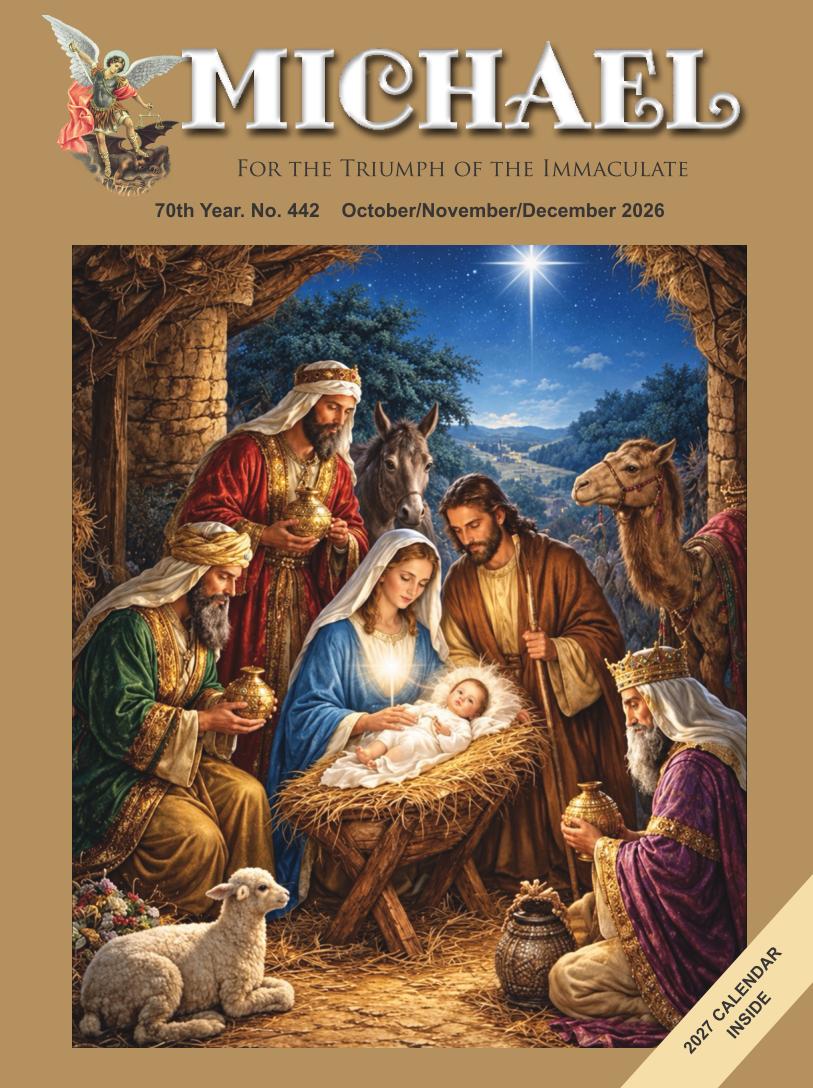
The social doctrine of the Catholic Church can be summed up in the basic principle that the human person has primacy. St. John XXIII wrote in his 1961 encyclical, Mater et Magistra: "The Church's teaching on social matters has truth as its guide, justice as its end, and love as its driving force.... The cardinal point of this teaching is that individual men are necessarily the foundation, cause, and end of all social institutions." All popes have reiterated this same basic principle, including Leo XIV in his encyclical, Magnifica Humanitas, which speaks of "the protection of the human person in the time of artificial intelligence" (see page 4).
In other words, all systems that govern life in society—including financial and economic systems, and even Artificial Intelligence—must be at the service of the human person, and not the other way around. Economic Democracy, or Social Credit, as conceived by Scottish engineer Clifford Hugh Douglas, shares the same philosophy (see page 41). Douglas wrote at the beginning of his first book, Economic Democracy: "Systems were made for men, and not men for systems, and the interest of man, which is self-development, is above all systems."
St. John Paul II wrote in his first encyclical, Redemptor Hominis (March 4, 1979, no. 15): "This difficult road of the indispensable transformation of the structures of economic life is one on which it will not be easy to go forward without…true conversion of mind, will and heart... Poverty amidst plenty brings into question the financial and monetary mechanisms... Man cannot relinquish himself or the place in the visible world that belongs to him; he cannot become the slave of things, the slave of economic systems, the slave of production, the slave of his own products."
Today, we have become slaves to the present financial system, which creates unpayable debts. By creating money and interest fees out of nothing, the banks become the owners of everything (see page 36). Artificial Intelligence, with all its abuses, is also making us increasingly enslaved: think of all the people who spend much of the day with their noses glued to a tablet or mobile phone. Leo XIV states this in paragraph 170 of Magnifica Humanitas: "The subtler forms of addiction linked to the "digital attention economy" should not be underestimated, since platforms and services are often designed to capture users'time and attention, exploiting their vulnerabilities and weakening their inner freedom."
In his encyclical, Pope Leo XIV insists that final decisions must remain in the hands of human beings, not machines, which "have no moral conscience, cannot judge good and evil, do not grasp the ultimate meaning of situations, and do not bear responsibility for consequences."
Another challenge brought about by Artificial Intelligence is the replacement of increasing numbers of wage earners by machines, which can perform the same tasks at a lower cost, more efficiently and without tiring. As Leo XIV writes, "The labour market is one area in which the risks associated with new technologies more clearly emerge."
What will become of all these former employees who no longer receive wages? How will they buy the goods produced by robots and other automated machines? The answer is clear to regular readers of MICHAEL: a monthly dividend must be paid to every citizen, based on the common inheritance of natural resources and progress, and financed by money created interest-free by the nation's national bank.
It is true that Leo XIV speaks in his new encyclical of the importance of work for the human person. But the Pope added: "It is certainly desirable for technology to relieve humans of arduous, repetitive or dangerous tasks and to provide intelligent support for human activity."
If a person is not engaged in paid employment, what will he do with his free time? He will devote it to freely chosen activities. It is precisely in his free time that a person can truly develop his personality, cultivate his God-given talents and put them to good use. Moreover, it is during their free time that men and women can attend to family, religious and social duties.
In reality, every human activity can be described as work, even when it is unpaid. St. John Paul II said the following on November 18, 1983, when he received in audience the participants of the Italian Episcopal Conference's meeting on the problems of work:
"The primary basis of work is in fact man himself... Work is for man, and not man for work.... Furthermore, it does not seem right to set time devoted to work in opposition to time free from work, since all of man's time must be regarded as a marvellous gift from God for his full and integral human development....
"Free time is the time in which people can and must attend to their family, religious and social duties. Better still, if it is to be a true moment of freedom and socially useful, this free time must be lived with mature ethical awareness, in a spirit of solidarity that is also expressed in appropriate forms of generous volunteer service."
All of us, whether wage earners or not, must fulfil our vocation by developing the gifts we have received from God in the service of our neighbours. Economic Democracy would make this possible. Enjoy the read!